
The problem: the answer is never in one place
Sustainability and carbon-market answers are scattered across project design documents, monitoring reports, registry records, methodology PDFs, ESG disclosures, supplier files, due diligence packs, market notes, country data, SDG indicators, technology assessments, and internal spreadsheets. The data is unstructured and messy, with no common format tying any of it together.
The hard part isn’t finding a document, it’s reading through all of it, cross-checking the details, and pulling out what actually matters before a decision has to be made. A carbon credit buyer may need additionality, permanence, leakage, stakeholder engagement, country context, and market activity before approving a purchase; a due diligence team needs to weigh the risks in a long project file against internal criteria; a procurement lead needs to know whether a supplier’s claims are actually supported by evidence.
General-purpose AI tools don’t help much here. They were trained on the open web, not on carbon-market documentation, so they have no reliable grasp of how a registry defines permanence, what a specific methodology requires for additionality, or how a monitoring report should line up with a project design document. Ask one a detailed carbon-market question and it will often produce a fluent, confident answer that is subtly, or completely, wrong, with no source you can check it against. In a market where a mistaken claim can cost real money and credibility, that isn’t good enough.
What you get: answers you can question, not just search results
CarbonAI Chat is built on deep carbon-market domain knowledge, not general text. It draws on thousands of registry documents, methodologies, monitoring reports, project design documents, and disclosures, so it understands the specific concepts these questions turn on, and answers in the language of the market rather than in generalities.
Instead of digging through scattered files, you ask a question in plain language and get a direct, source-linked answer, with the underlying public evidence attached so you can verify it yourself.
You don’t just get an answer, you get the evidence and the reasoning behind it. CarbonAI Chat pulls the relevant claims, risks, comparisons, and source references together into one place, so you can keep asking follow-up questions against the same body of evidence instead of rebuilding the context from scratch each time. It changes the starting point from "where do I search?" to "what do I need to know?"
Who it’s for
- Sustainability leads turning scattered project documents into a clear, referenced briefing they can hand to finance, legal, or the board.
- Carbon credit buyers surfacing the evidence behind a project’s claims before approving a purchase.
- Due diligence and risk analysts structuring the risks, gaps, and open questions buried in a long project or counterparty file.
- Procurement teams checking whether a supplier’s or developer’s sustainability claims actually hold up against the evidence.
- Investors and analysts connecting ESG risk, SDG need, country exposure, and market behavior into a single view.
- Legal, audit, and compliance reviewers who need answers they can trace back to a source, not a confident but unverifiable summary.
What you can do with it
- Run a due diligence review: ask it to identify risks, missing evidence, claims, safeguards, and follow-up questions from project or counterparty documents.
- Screen a VCM project: compare additionality, monitoring, permanence, leakage, stakeholder engagement, and project status before a credit moves into deeper review.
- Do sustainability research: explore ESG, SDG, country, and technology context without manually stitching together multiple datasets and reports.
- Support procurement: review supplier or developer claims and see exactly what evidence backs them.
- Prepare internal briefings: generate source-linked summaries for finance, legal, procurement, investment committees, or senior leadership.
- Read market intelligence: ask about buyer behavior, retirement activity, project types, and market trends across the connected CarbonAI data.
- Get general sustainability guidance: ask about frameworks, terminology, best practice, or how to approach a problem you haven’t tackled before, not just questions tied to a specific document.
How CarbonAI Chat is different from a general chatbot
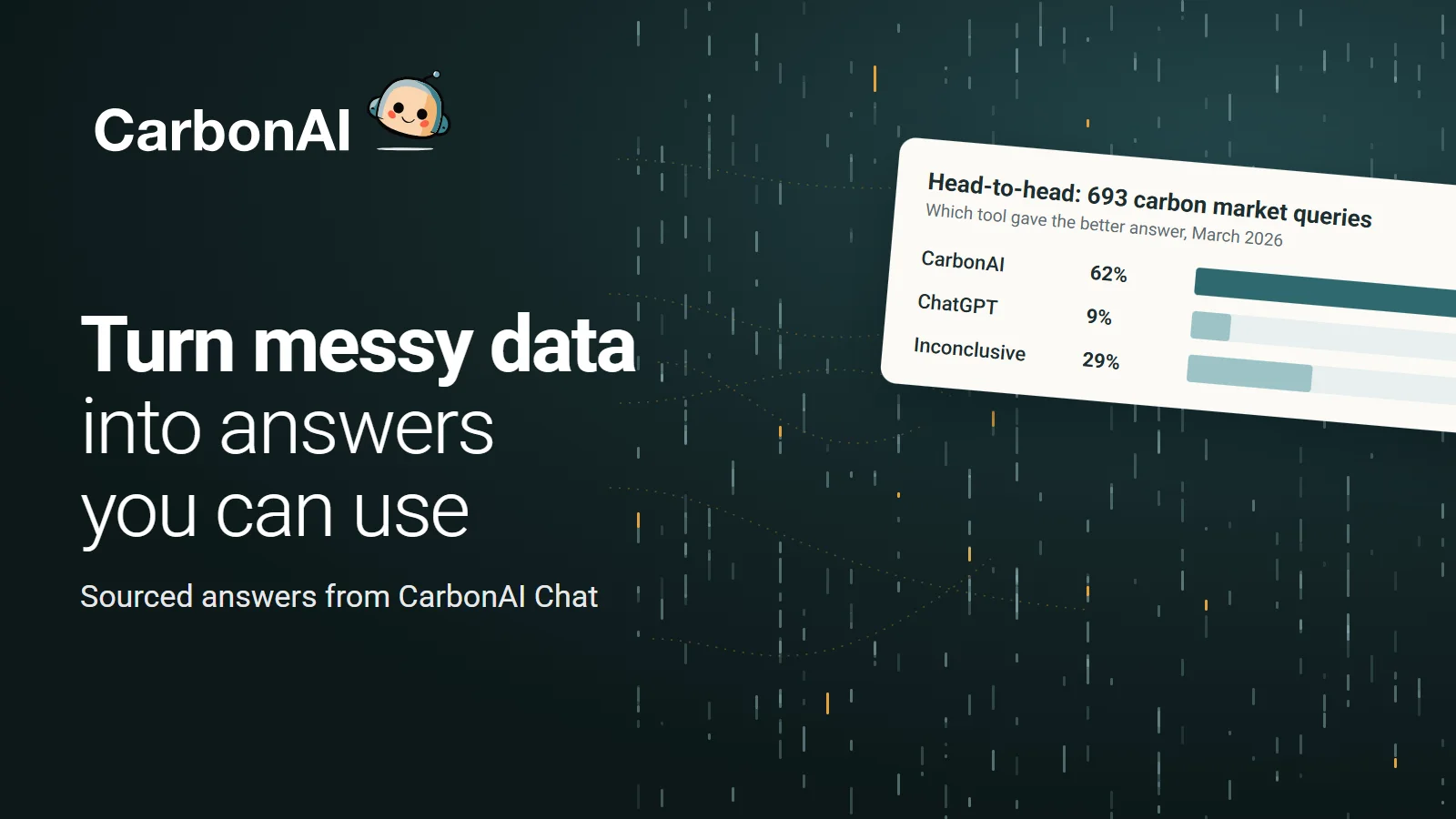
General AI tools can summarize text, but sustainability and carbon-market decisions need more than a fluent summary; they need evidence, context, traceability, and domain-specific logic. A generic chatbot will answer a carbon-market question from general web text and often get it confidently wrong. That gap is measurable. In March 2026 we tested CarbonAI head-to-head against ChatGPT on 693 real-world carbon market queries. CarbonAI produced the better answer in 62% of cases, ChatGPT in 9%, with the remainder inconclusive.
CarbonAI Chat is grounded in the carbon-market evidence base the wider platform is built on. Each ratings cycle alone processes over 1.03 billion tokens of unstructured text, roughly 1.17 million pages across 76,000 project files from leading registries including Verra, Gold Standard, ACR, and CAR, and Chat also draws on CarbonAI’s country, SDG, technology, and ESG indices, project features, and market behavior. Every answer links back to that evidence, so it can be checked and defended.
It’s built to support due diligence, not replace it. Answers are informational and should be reviewed alongside independent judgment, applicable rules, and project-specific analysis. The goal isn’t to remove experts from the process; it’s to let them spend less time untangling messy data and more time making better decisions.
Too much to read, not enough time to chase it across PDFs, registries, and spreadsheets. Ask CarbonAI Chat your hardest questions and get one sourced answer. Get started with CarbonAI.