
The problem: "where will this do the most good?" has never had a real answer
Every organization that works across borders eventually faces the same question: of all the countries we could focus on, where will what we do matter most? Whether the decision is an investment, a sourcing strategy, a development program, a grant, or a market entry, the honest answer is usually built on familiarity, existing relationships, or where the organization already operates.
The reason is simple: there hasn’t been a consistent, comparable way to measure where a country’s structural development needs are deepest, and therefore where an intervention has the greatest potential to matter. Development need is multi-dimensional and spread across economic, social, environmental, political, and institutional conditions, and pulling that into a single comparable picture across every country is genuinely hard. So the question of where impact is greatest has stayed a matter of judgment rather than evidence.
What you get: a multi-dimensional measure of development need
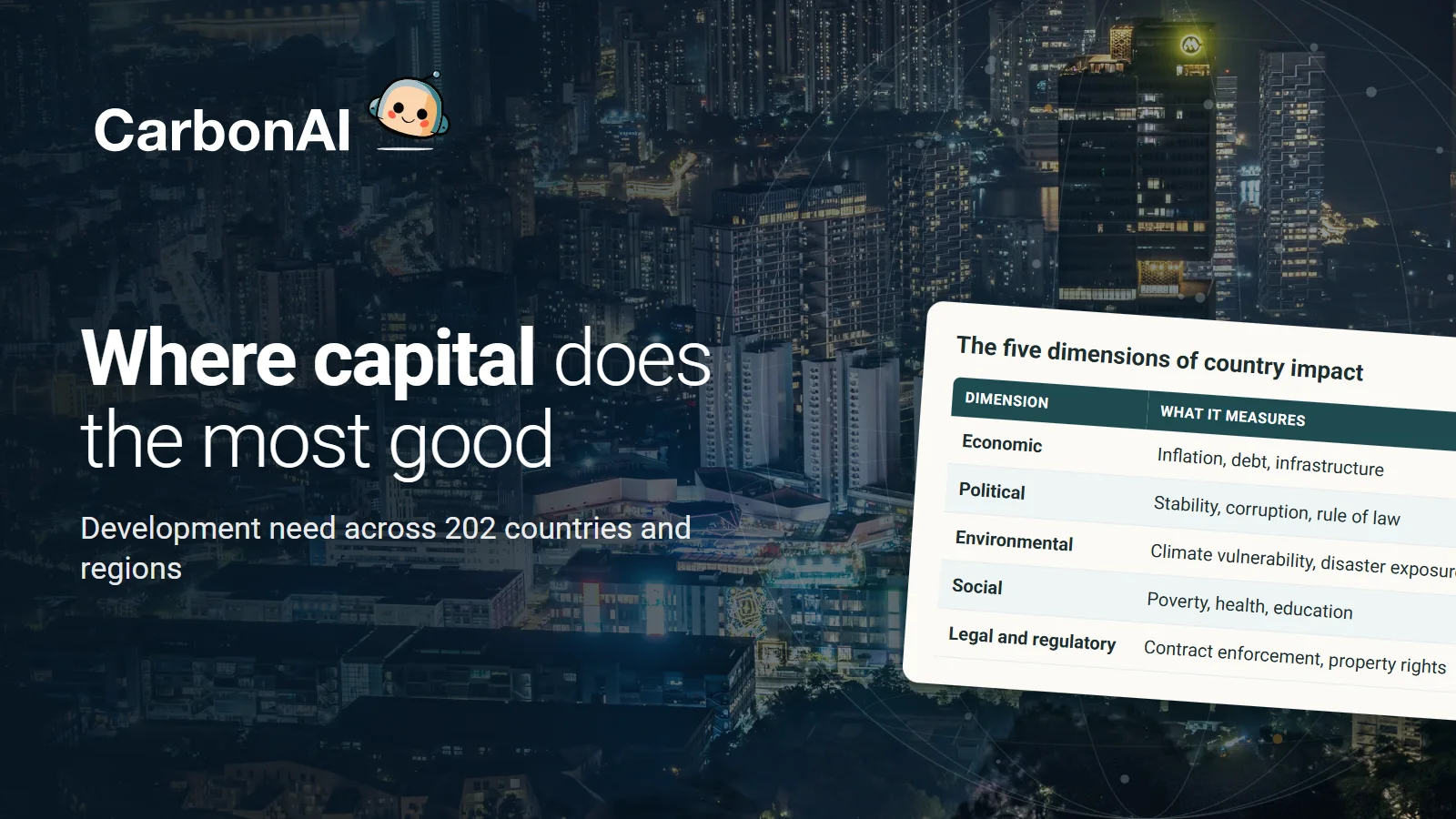
The Country Impact Index (CII) is an AI-powered, country-level framework that quantifies unmet structural development need across five dimensions: economic, political, environmental, social, and legal and regulatory. Each of the 202 countries and regions is scored annually on a 1-to-100 scale, from 1 (no need) to 100 (systemic collapse), so higher scores point to where interventions have the greatest potential to matter.
The score isn’t a black-box label: it decomposes across five sub-indices, so you can see whether a country’s need is driven by economic gaps, environmental vulnerability, social conditions, institutional weakness, or political factors. Scores run annually back to 2005, more than 20 years of data, built on over a million public data points from sources such as the World Bank, OECD, and United Nations, so you see trajectory as well as today’s snapshot.
What each dimension actually measures
Economic
- Economic performance
- Inflation
- Employment and skills
- Public and private debt
- Exchange rate and trade
- Credit and capital
- Infrastructure
- Taxation
Political
- Political stability
- Corruption
- Regulatory environment
- Rule of law
- Security
- Government effectiveness
Environmental
- Climate vulnerability
- Natural resource management
- Environmental regulations
- Natural disaster exposure
- Renewable energy adoption
Social
- Demographic trends
- Income inequality and poverty
- Health and well-being
- Education
- Urban and rural dynamics
Legal and regulatory
- Legal independence and effectiveness
- Contract enforcement
- Property rights and IP
- Regulatory structures
Who it’s for
- Investment and allocation teams deciding which countries to prioritize and needing an evidence-based rationale for where to focus.
- Development finance and impact investors directing capital toward the geographies where unmet need, and therefore impact potential, is greatest.
- CSR, philanthropy, and foundation teams channeling programs and grants to the countries and themes where they can move the needle most.
- NGOs and government planners prioritizing program areas with decomposable, defensible, country-level evidence.
- Strategy, market-entry, and supply chain teams assessing country conditions across five dimensions in one consistent, comparable framework.
- Researchers and analysts working with a consistent longitudinal dataset covering 202 countries and regions from 2005 onward.
What you can do with it
Explore the Country Impact Index at three levels: view an individual country’s profile, compare countries across the overall index and its components, or classify countries into comparable groups based on their CII results.
- Prioritize geographies by impact potential: rank candidate countries by where structural need, and therefore the potential benefit of acting, is highest.
- Understand what’s driving a country’s need: break any score into its economic, political, environmental, social, and legal sub-indices to target the right intervention.
- Defend an allocation decision: replace "this is where we’ve always operated" with a structured, evidence-linked rationale a board or committee can scrutinize.
- Track how a country is changing: use annual scores back to 2005 to see whether conditions are improving or deteriorating over time.
- Sequence deeper due diligence: screen countries first, then concentrate project-, partner-, or investment-level review where the need, and the opportunity, is greatest.
How CarbonAI does this differently
The hard part of country assessment isn’t opinion; it’s reconciling a vast, constantly changing evidence base into something comparable. A skilled analyst can read the situation in a handful of countries; no team can consistently weigh more than a million public data points across 202 countries and regions, every year back to 2005, and keep the judgment identical each time.
CarbonAI is built to close exactly that gap, by combining human expertise with machine scale. Domain experts define the taxonomy, what each of the five dimensions means and which indicators legitimately belong to it, and every public indicator is mapped to that structure by rule rather than ad hoc. The measurement itself then runs continuously across the full dataset and refreshes as new data lands, so scores stay current rather than frozen at the last manual review.
The result is the best of both: expert-defined judgment about what matters, applied with a consistency, breadth, and freshness no manual process can match, and every score still traces back to public sources so it can be checked and defended.
See where capital can create the greatest impact. Explore the Country Impact Index in CarbonAI Assess.