
The problem: technology and country are treated as separate decisions
A technology that creates meaningful development benefit in one country may have only marginal value in another. A solar irrigation project can be transformative where agricultural water stress and limited electrification are acute; the same technology matters less where grid access and irrigation infrastructure are already mature.
Climate finance often runs on technology-led narratives, and solar, mangroves, biochar, blue carbon, direct air capture, and energy efficiency all have compelling general use cases. But the right question is not whether a technology is attractive in general. It’s whether that technology addresses a real, country-specific need and can realistically work in that location. Until now there hasn’t been a consistent way to measure that fit.
What you get: a country-by-technology fit score
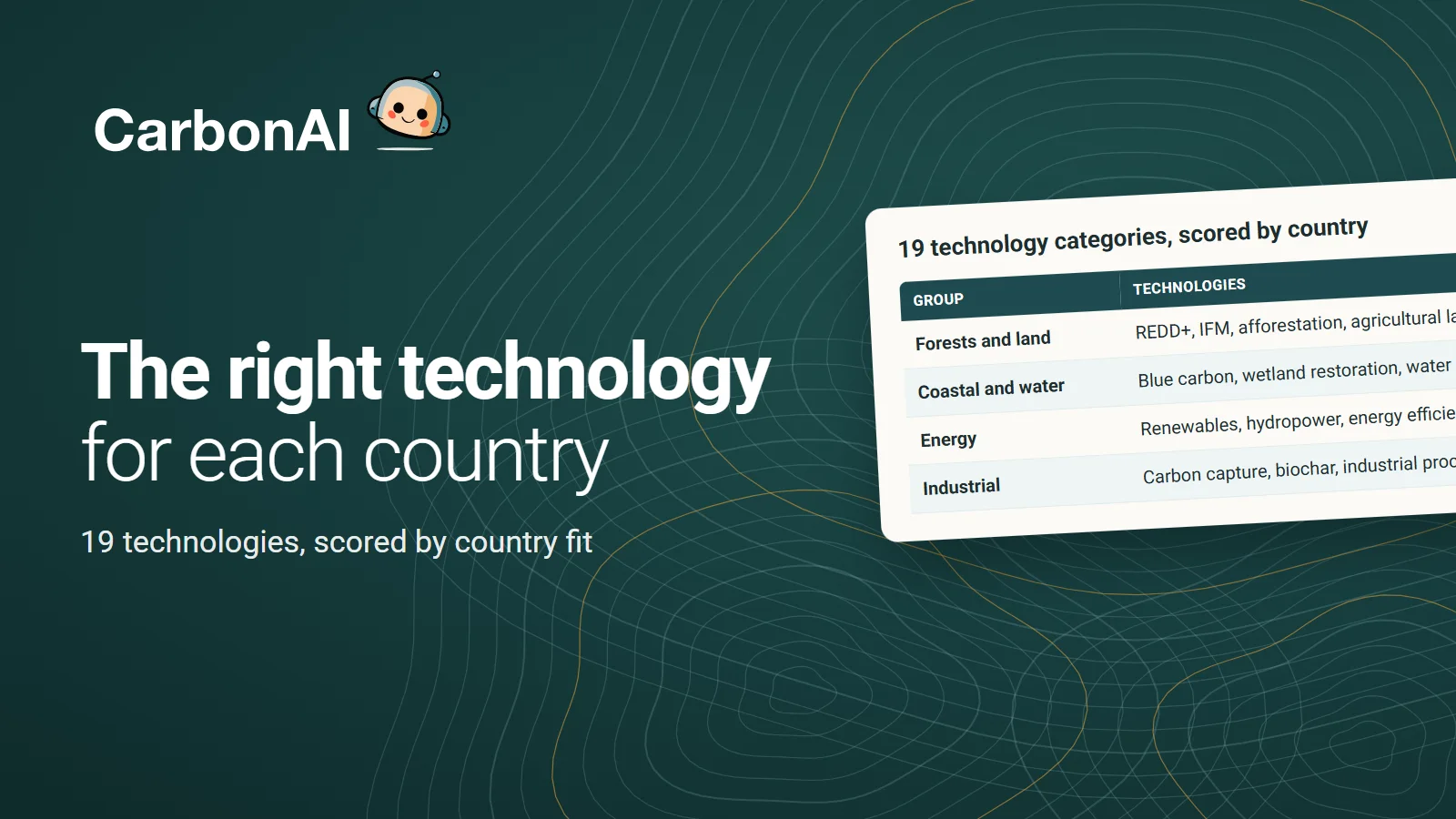
The Technology Impact Index (TII) is a country-level framework that scores how well technologies align with the SDG-related development needs and feasibility conditions of each country. It covers 202 countries and regions and 19 technology categories, recalculated annually since 2005 on a 1-to-100 scale, where higher scores indicate stronger country-technology impact potential.
Each score measures how well a technology addresses a country’s most acute, SDG-aligned development needs, weighing technology-specific contextual indicators alongside feasibility factors such as geography, climate, natural resources, land conditions, and infrastructure. A technology scores well when it fits the country, not simply because it performs well somewhere else.
The scoring doesn’t rely on public indicators alone. An AI-based feasibility check tests whether a technology is even viable in a given country before it can score, screening out physical mismatches, such as coastal blue-carbon or mangrove restoration in a landlocked country with no coastline, so a technology never scores well somewhere it simply cannot be deployed.
What the index covers
Forests and land
- Afforestation and reforestation
- Improved forest management
- Reducing emissions from deforestation and forest degradation (REDD+)
- Avoided conversion of natural ecosystems
- Agricultural land management
Coastal and water
- Blue carbon
- Wetland restoration
- Water management
Energy
- Renewable energy
- Hydropower
- Energy efficiency
- Energy efficiency in community-based projects
- Energy efficiency in transportation
- Energy efficiency through recycling processes
- Energy efficiency using gas, landfill gas, or biomass
Industrial and engineered
- Carbon capture and storage
- Emissions reduction from industrial processes
- Biochar production and application
- Ozone depleting substances
Who it’s for
- Project developers screening countries and technologies before committing resources to feasibility work.
- Buyers and procurement teams checking whether a project’s technology addresses a meaningful local gap in its host country.
- Infrastructure and climate finance investors comparing technology opportunities across markets on one consistent scale.
- Governments and public institutions supporting technology needs assessments, Nationally Determined Contributions (NDC) planning, and technology transfer priorities.
- CSR and supply chain teams choosing technology interventions that match the needs of the communities where they operate.
What you can do with it
Explore the Technology Impact Index through the overview, country profile, peer comparison, country and regional comparison, and classification dashboards. Assess overall technology development needs, compare countries across carbon project categories, and identify where low-carbon technologies could have the greatest potential impact.
- Design projects country-first: identify which technologies carry the strongest SDG-aligned impact potential in a target country before feasibility spend.
- Deepen due diligence: compare whether similar projects in different geographies have genuinely different impact potential.
- Screen investment pipelines: rank clean technology opportunities against national needs rather than global averages.
- Prioritize climate finance: direct funding where country-technology alignment is strongest, with two decades of trend data behind the score.
- Support research and planning: analyze how technology relevance shifts across countries and time on a consistent 1-to-100 scale.
How CarbonAI does this differently
Assessing whether a technology fits a country is expert judgment, but doing it for 19 technology categories across 202 countries and regions, every year back to 2005, is beyond what any team can weigh by hand. Generic rankings sidestep the problem by scoring technologies on average, which strips out precisely the context a real project decision needs.
CarbonAI is built the other way around. Human experts define the framework: which technologies credibly serve which needs, and how feasibility should be weighed. Every indicator is then mapped to that structure by rule. The measurement then runs at machine scale over more than a million public data points and refreshes as new data lands, so a fit score reflects both expert-defined logic and current, country-specific conditions.
The TII doesn’t replace project-level integrity checks such as additionality, permanence, leakage, monitoring, or stakeholder engagement; those sit in CarbonAI’s Project Ratings. What it adds is the context those checks can’t see, applied consistently everywhere: whether the technology is likely to matter in the place it’s being deployed.
Match technologies to the countries where they deliver the greatest benefit. Explore the Technology Impact Index in CarbonAI Assess.