
The problem: most supply chain due diligence happens too late
Most supply chain due diligence happens too late: after a supplier is onboarded, after a contract is signed, after a headline breaks. The standard approach is well-intentioned but backwards: send an audit questionnaire, review a self-reported SMETA, tick the box. None of that tells you what you are walking into before you make the decision.
The pressure to get this right keeps rising. The EU’s Corporate Sustainability Due Diligence Directive (CSDDD), the U.S. Uyghur Forced Labor Prevention Act (UFLPA), CBAM, and disclosure regimes like ISSB S1 and S2 all expect organizations to identify, evidence, and act on ESG risk across their value chains, country by country. Assembling that picture by hand, across sourcing countries, sectors, frameworks, and constantly shifting conditions, is slow, inconsistent, and hard to defend.
What you get: a country-level, evidence-based supply chain assessment
CarbonAI’s Supply Chain CSR Risk Assessment generates structured, data-driven country-by-industry risk reports for any country and any sector, before sourcing begins. Each report is grounded in authoritative institutional indicators from the World Bank, OECD, ILO, IMF, and United Nations, layered with contextual intelligence on recent regulatory, labor, and market developments.
The output tells you the structural risk conditions of a sourcing country and sector before you’ve committed to a supplier relationship. Every finding traces back to its source, so a sourcing decision or due-diligence file rests on evidence you can show, not a black-box score.
A concrete example: apparel and footwear in Turkey
Take Turkey’s apparel and footwear sector, a $30+ billion export industry and a major nearshoring destination for European fashion brands. On the surface it looks attractive: strong logistics and port connectivity, EU Customs Union access, vertical integration from yarn to finished garment, and shorter lead times into Europe than Bangladesh or Vietnam.
Look deeper, and the picture changes. Dense subcontracting networks with limited visibility beyond tier one. Informal workshops outside standard audit scope. Syrian and migrant workers with limited legal status and weak grievance access. Earthquake-affected production zones with elevated risk of wage non-compliance and unauthorized subcontracting.
This is what country-level structural risk looks like. It doesn’t show up in a supplier questionnaire; it’s baked into the operating environment long before you pick a factory.
Country-level risk doesn’t disappear because your factory passed an audit. It concentrates in the places your audit didn’t reach.
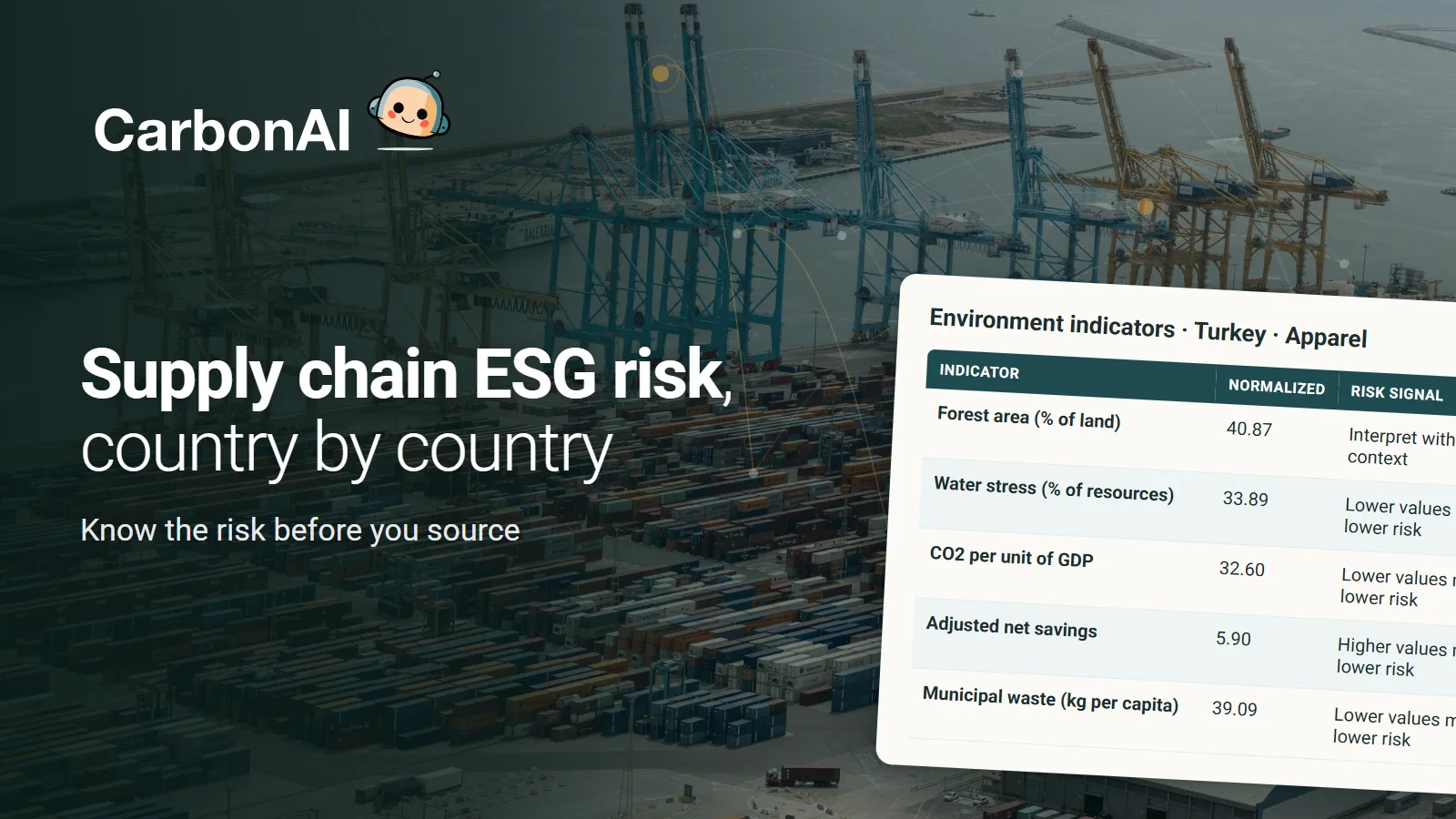
Here is a quick look at the environment risk analysis CarbonAI performed for Turkey:
Environment · Turkey · Apparel, accessories, and footwear
Water stress and resource efficiency gaps
Material freshwater stress and weak natural-capital preservation expose industrial users to allocation limits, pollution-control costs, and ecosystem degradation. The World Bank approved $600 million in 2024 for Türkiye’s flood and drought resilience.
Water-intensive apparel manufacturing exposure
Risk concentrates in wet processing (dyeing, washing, finishing, and wastewater) across Istanbul, Bursa, Izmir, Denizli, and Gaziantep, where cumulative water demand and effluent loads compound. The EU Waste Shipment Regulation, in force since 2024, raises waste-traceability expectations for exporters.
Each finding is backed by indicator-level detail, normalized to a comparable 0-to-100 scale:
| Indicator | Raw | Normalized | Risk signal | Year and source |
|---|---|---|---|---|
| Forest area (% of land area) | 29.28 | 40.87 | Interpret with sector context | 2022, World Bank |
| Level of water stress: freshwater withdrawal as % of available resources | 43.38 | 33.89 | Lower values mean lower risk | 2021, World Bank |
| CO2 emissions per unit of GDP | 0.17 | 32.60 | Lower values mean lower risk | 2020, World Bank |
| Adjusted net savings, including natural resource depletion | 0.00 | 5.90 | Higher values mean lower risk | 2020, World Bank |
| Municipal waste (kilograms per capita) | 414.72 | 39.09 | Lower values mean lower risk | 2020, World Bank |
The report also maps the regulatory exposure for buyers sourcing from that country and sector:
| Regulation | Jurisdiction | Triggered? | Basis |
|---|---|---|---|
| UK Modern Slavery Act | UK | Reporting required | Labor rights score plus subcontracting depth triggers the s.54 transparency statement obligation for qualifying UK buyers |
| FCPA and UK Bribery Act | US and UK | Elevated | WGI Control of Corruption score 58/100; intermediary use in Turkish apparel procurement warrants enhanced third-party due diligence |
What you get
- Pillar-by-pillar risk analysis: a clear picture of where exposure is elevated across all six ESG dimensions for your country and sector.
- Indicator-level evidence: the underlying data points driving each score, with source attribution and risk direction.
- Recommended actions: prioritized, practical steps for each risk area: what to check, what to require, and where to focus diligence.
- Contextual intelligence: recent regulatory changes, labor developments, and market conditions that affect your sourcing environment right now.
- Competitor analysis: country-level comparison of selected industry competitors.
- Regulatory exposure: key regulatory developments and compliance signals to monitor that could affect your sourcing activities and supply chain risk.
Who it’s for
- Procurement and sourcing teams comparing sourcing countries and sectors on a consistent evidence base before committing volume.
- Compliance and legal teams evidencing country-level due diligence under CSDDD, UFLPA, and similar regimes.
- ESG and sustainability teams grounding supply chain disclosures in something defensible for ISSB, CSRD, and GRI reporting.
- Auditors and assurance providers who need country-level findings that trace back to public, verifiable institutional sources.
How CarbonAI does this differently
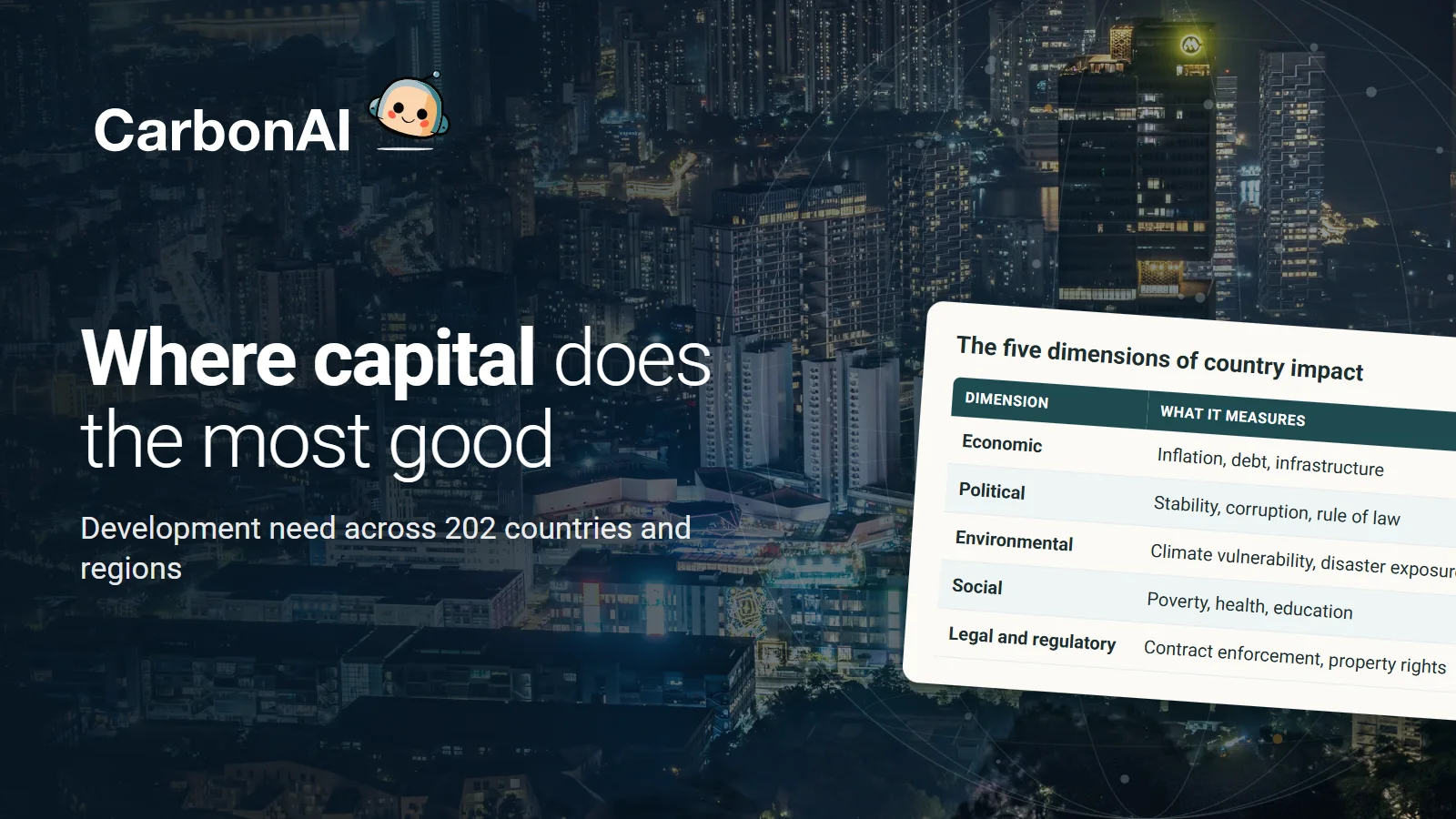
Most supply chain risk tools rely on a single opaque country risk label, or on what suppliers choose to disclose; rarely both, and rarely traceable. CarbonAI grounds every assessment in a country indicator backbone structured from authoritative public sources (the World Bank, OECD, ILO, IMF, and United Nations) covering 202 countries and regions with more than two decades of data, layered with contextual intelligence on current regulatory and market conditions.
It is built to support due diligence, not replace it. The output is a structured, evidence-based assessment to inform review and decisions, used alongside independent judgment and the specifics of each supplier relationship.
If you work in sourcing, ESG, or investment and want to see what a report looks like for a country and sector you care about, contact us.