
The problem: two opposite failures, one underlying risk
Say too much and you risk greenwashing: environmental claims that are vague, exaggerated, or unsupported, exactly what regulators like the UK’s CMA and ASA, and disclosure regimes across the EU, now actively police. Say too little and you risk greenhushing: under-communicating real climate work, so stakeholders can’t form a reasonable view of how you’re actually managing climate risk. Both are transparency failures, and both carry regulatory and reputational consequences.
The hard part is that checking for either one by hand is slow and inconsistent. Someone has to read every page of a website or report, know the specific rules that apply in the relevant jurisdiction, judge each claim against them, and separately work out which expected disclosures are simply absent. Across a large corporate site, that is hundreds of pages and dozens of rules, and the answer changes with every jurisdiction.
What you get: a jurisdiction-aware audit of both risks
You give CarbonAI a web link. It crawls the site from there, along with any PDFs it finds linked from those pages, then audits the content in two ways: for greenwashing, it checks the claims you do make; for greenhushing, it checks the disclosures you don’t.
On the greenwashing side, it extracts every environmental claim on the crawled pages, and in any PDFs found on them, categorizes it, and rates its misleading potential as high, medium, or low against the rule set for the chosen jurisdiction. In the UK, that’s the CMA Green Claims Code and ASA guidance. EU assessments are run against the UCPD as amended by the 2024 Green Transition Directive, and Swiss assessments are run against the UWG, with the ICC Code applied as interpretive guidance. Each flagged claim comes with a plain-English rationale, the specific rules it may breach, the exact URL of the page it was found on, and a concrete suggestion for making it defensible.
On the greenhushing side, it measures disclosure coverage against the IFRS S2 climate-disclosure framework (four pillars covering governance, strategy, risk management, and metrics and targets; 15 sub-categories; and 80 individual disclosure items) and flags, item by item, whether each expected disclosure is present or absent. You see coverage per category, the specific items not found, and every page that was reviewed.
The result is an auditable report, not a verdict: overall scores, a claim-by-claim and item-by-item breakdown, and a full URL index, all traceable to the source so it can be checked, shared, and acted on.
Greenwashing examples
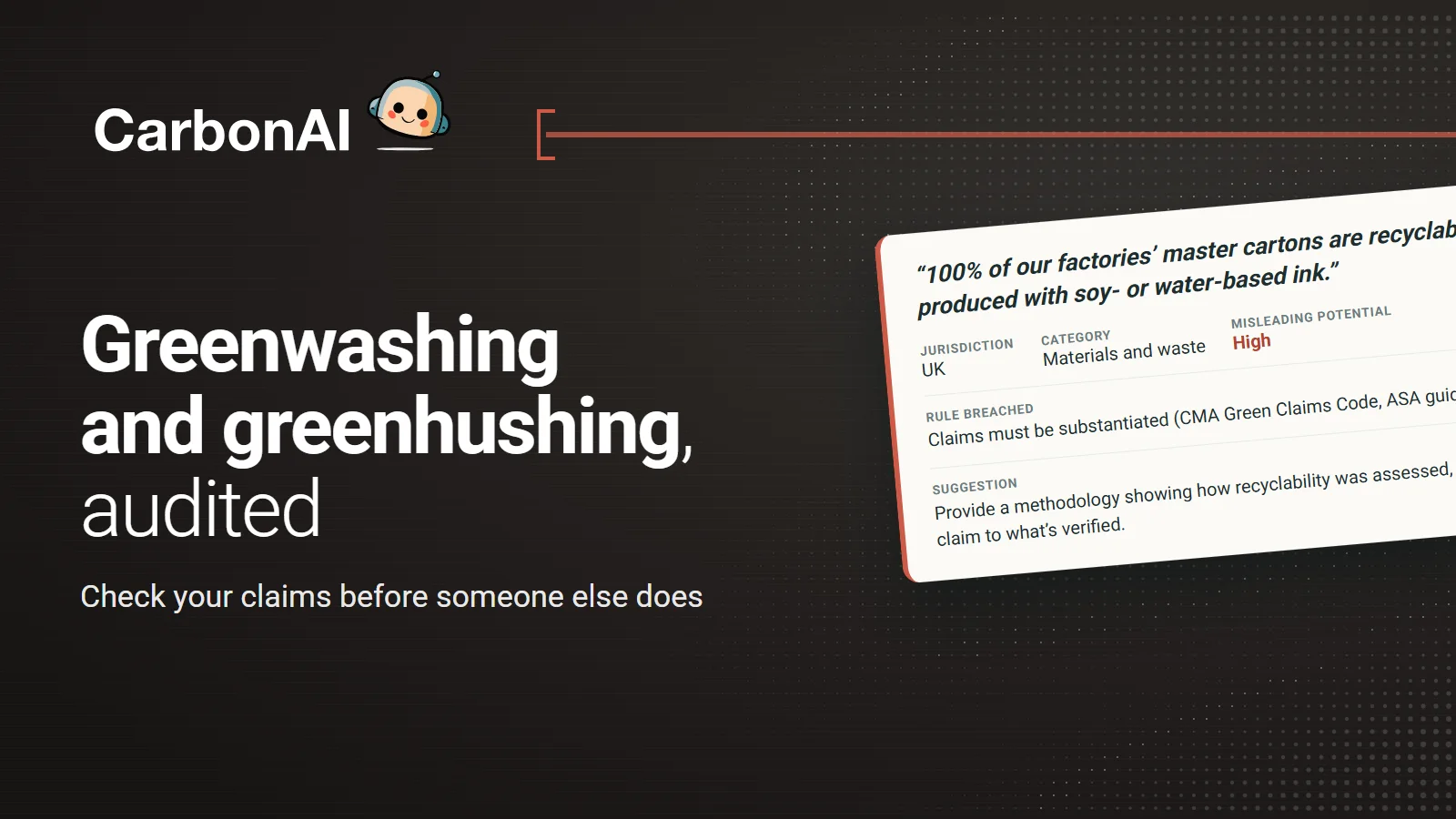
For each greenwashing claim found, the report highlights the breached rule, the rationale, and a recommended action.
“100% of our factories’ master cartons are recyclable and produced with soy- or water-based ink.”
- Jurisdiction
- UK
- Category
- Materials and waste
- Misleading potential
- High
- Rule breached
- Claims must be substantiated (CMA Green Claims Code, ASA guidance)
RationaleUnqualified “100%” claim with no explanation of what “recyclable” means in practice or supporting evidence.
SuggestionProvide a methodology or documentation showing how recyclability was assessed, or scope the claim to what’s actually verified.
“...has saved over 100 tons of CO2e compared to an industry standard grocery store since it opened.”
- Jurisdiction
- EU
- Category
- Climate and carbon
- Misleading potential
- High
- Rule breached
- Claims must be shown as specific only where substantiation is clear and prominent on the same medium (Directive 2005/29/EC (UCPD), Article 2(p), inserted by Directive (EU) 2024/825, recital 9). Comparative claims must disclose their methodology (Directive 2005/29/EC (UCPD), Article 7(7), inserted by Directive (EU) 2024/825).
RationaleQuantified comparison made without disclosing the baseline definition, timeframe, or data source needed to substantiate it.
SuggestionPublish the calculation methodology, baseline definition, time period, and underlying data or independent verification alongside the claim.
Greenhushing examples
The greenhushing report flags each disclosure item as found or not found, so you can see which ones are covered and which are missing. For each item, the report highlights the evidence found or identifies disclosure gaps, and provides the sources supporting the assessment.
| Disclosure item | Status | Evidence summary | Sources |
|---|---|---|---|
| What actions, programs, or initiatives support delivery of its climate strategy | Found | A dedicated science exchange initiative works to solve complex, long-term sustainability challenges that are hard to fully address with technologies readily available today, creating mechanisms to develop new solutions that help meet collective sustainability goals. | URL 5, URL 10 |
| Has adaptation or resilience planning | Not found | No evidence found | None |
| Expects to remain viable or resilient over time | Found | By scaling carbon-free energy, the company aims to become a more resilient and sustainable business, drive a global transition to cleaner energy, and meet its commitment to reach net-zero carbon emissions by 2040. | URL 3, URL 14 |
Who it’s for
- Sustainability and communications teams pressure-testing a website or campaign against the rules before it is published, not after a regulator or journalist raises it.
- Legal and compliance reviewers who need each claim mapped to the specific rule it may breach, with a source and a suggested fix, to sign off with confidence.
- ESG and disclosure teams checking their climate disclosures against the IFRS S2 structure to find the gaps a reader, or an auditor, would notice.
- Investors, buyers, and procurement teams assessing whether a counterparty’s public environmental claims hold up, and whether their disclosure is complete.
- Agencies and consultants auditing client sites and reports across different jurisdictions from one consistent, evidence-backed process.
What you can do with it
- Audit your own site before anyone else does: crawl your public pages and any PDFs linked from them and see every claim that could be read as misleading, ranked by potential, with a fix for each.
- Choose the jurisdiction that applies: run the same content against the relevant rule set for the UK, EU, or Switzerland and get findings specific to it.
- Find your greenhushing gaps: see where you are doing genuine climate work but not disclosing it, measured against all 80 IFRS S2 disclosure items.
- Fix claims with concrete guidance: use the per-claim rationale and suggestion to rewrite vague or absolute statements into defensible ones.
- Vet a counterparty or competitor: point the tool at their site or report to see how their claims and disclosures would hold up.
- Hand legal an evidence file: export a source-linked report mapping every finding to a rule and a URL, instead of a verbal assurance.
How CarbonAI does this differently
A general AI tool can comment on whether a sentence sounds like greenwashing. It doesn’t know the CMA Green Claims Code, the ASA rules, the EU’s UCPD, the Swiss UWG, or the 80 disclosure items in IFRS S2, and it can’t tell you which specific rule a claim breaches or whether a given disclosure item is present. That is the difference between an opinion and an audit.
CarbonAI is built on jurisdiction-specific rule sets and disclosure frameworks encoded by domain experts, then applied consistently across every page of a site or document. Every greenwashing finding is mapped to the exact rule it may breach, and the URL it came from; every greenhushing gap is mapped to a specific IFRS S2 item. It covers both over-claiming and under-disclosure in a single, jurisdiction-aware pass, at a scale and consistency manual review can’t match.
It is built to support review, not replace it. The output is a structured transparency assessment, not a legal opinion or a formal compliance finding, and some items flagged as gaps may be addressed elsewhere or handled through other channels. The goal is to show you exactly where your climate communication could be clearer, better supported, or more complete, before it matters.
Audit a page or a report against the rules that apply to you. Try the greenwashing and greenhushing audit in CarbonAI Communicate.