
The problem: quality is invisible at the moment you’re buying
Every carbon project comes with its own documentation, written in its own format, to its own standard. One project’s monitoring section runs forty pages; another covers it in two. One registry structures co-benefit evidence one way; another does it completely differently. The problem isn’t a lack of information, and it isn’t anyone’s honesty; it’s that nothing is presented on the same terms, so comparing one project to another means comparing documents that were never designed to be compared.
The cost of getting it wrong isn’t abstract. A credit that turns out to be low quality doesn’t just waste budget; it exposes the buyer to greenwashing accusations, unwound claims, and uncomfortable questions from boards, auditors, and journalists. In today’s market, the credit you buy is a public statement about your judgment.
What you get: one consistent score across the whole market
CarbonAI’s VCM Project Ratings score every project against the same published methodology, so a forestry project in Brazil and a cookstove project in Kenya, registered with ACR, Verra, Gold Standard, CAR, Puro, or Isometric, land on a scale that actually means the same thing regardless of which registry issued the credits. Instead of a subjective quality label from one review, you get an independent, evidence-based rating you can defend.
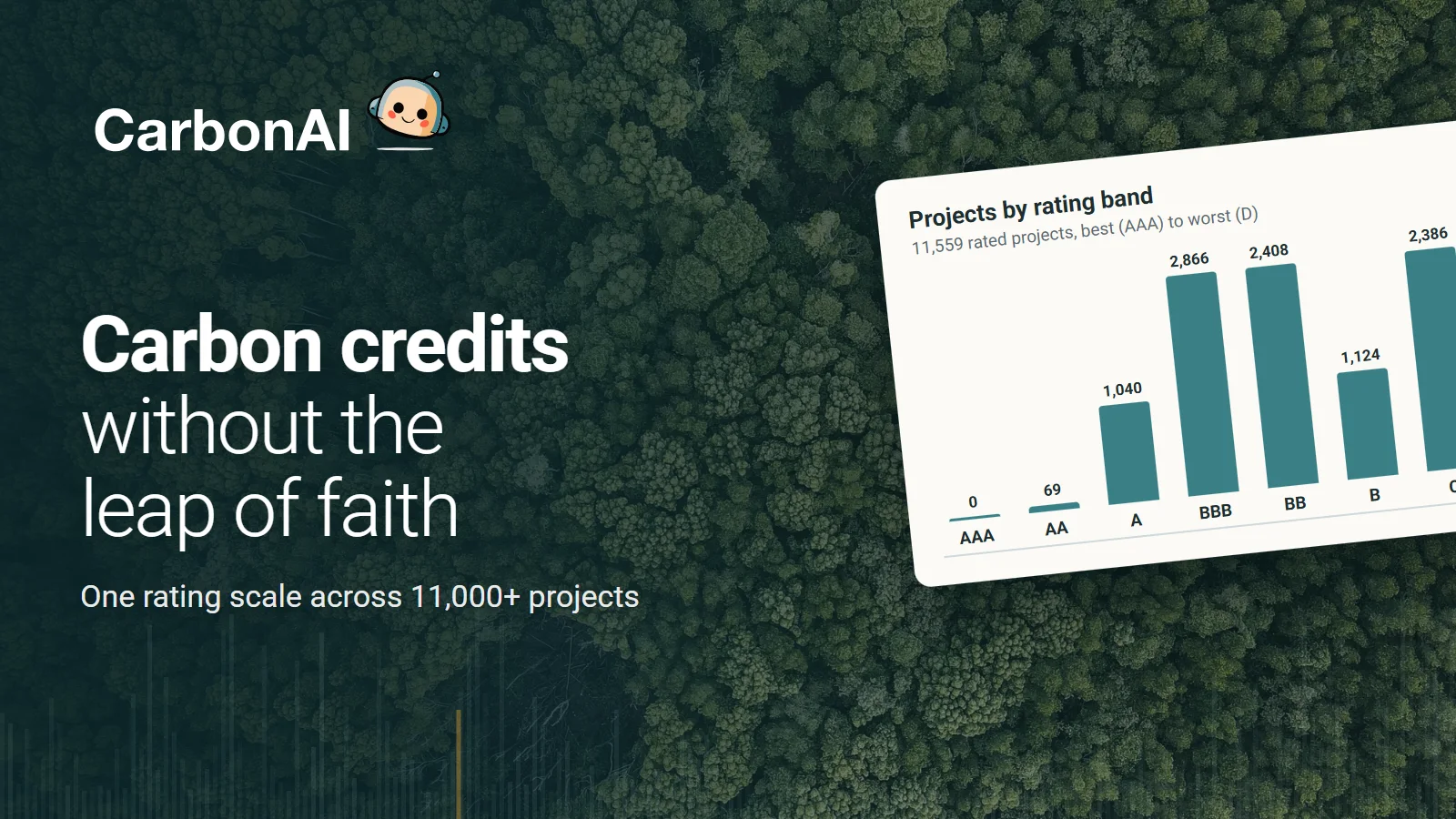
Every project lands on one scale, AAA at the top down to D at the bottom, so a rating carries the same meaning whether it sits on a cookstove project in Kenya or a forestry project in Brazil.
| Rating band | Projects | Share of total |
|---|---|---|
| AAA | 0 | 0.0% |
| AA | 69 | 0.6% |
| A | 1,040 | 9.0% |
| BBB | 2,866 | 24.8% |
| BB | 2,408 | 20.8% |
| B | 1,124 | 9.7% |
| C | 2,386 | 20.6% |
| D | 1,666 | 14.4% |
CarbonAI can assess 11,559 projects across 13 features every week: just over 150,000 feature-level assessments, each cited back to source, refreshed every seven days. A review team doesn’t do this more slowly. At this scale and this cadence, it isn’t something a review team does.
Each project is scored across 13 features, from additionality and permanence to leakage, monitoring, and targeted SDGs, and every score is evidence-based and fully cited, with source references and a transparent, published methodology behind it. A rating isn’t just a number: it’s a citation trail a buyer, auditor, or investment committee can follow back to the underlying documents.
And because ratings refresh weekly, almost in real time, rather than being frozen at issuance, you get an early warning if a project you already hold starts slipping, a lost certification or a monitoring gap, before it becomes a headline. That’s the difference between catching a problem quietly and explaining one publicly.
| Feature | What it measures |
|---|---|
| SDG Contributions & Certifications | Alignment with UN SDGs and integrity certifications like Article 6, CCP, and CORSIA |
| Permanence | Likelihood that stored or avoided emissions could be reversed, based on safeguards and environmental risk |
| Leakage | Whether emissions reductions are just displaced outside the project boundary |
| Methodology | Whether the project runs under an active, current, compliant methodology |
| Proponent | Track record, technical experience, and reliability of the project developer |
| Stakeholder Engagement | Depth and quality of local community involvement |
| Project Status | Real-time operational health and viability of the project |
| Credit Activity | Liquidity, transaction history, and market confidence behind the project’s credits |
| Monitoring | Timeliness and consistency of monitoring and reporting |
| Technology Impact Index (TII) | How well the project’s technology matches its host country’s needs |
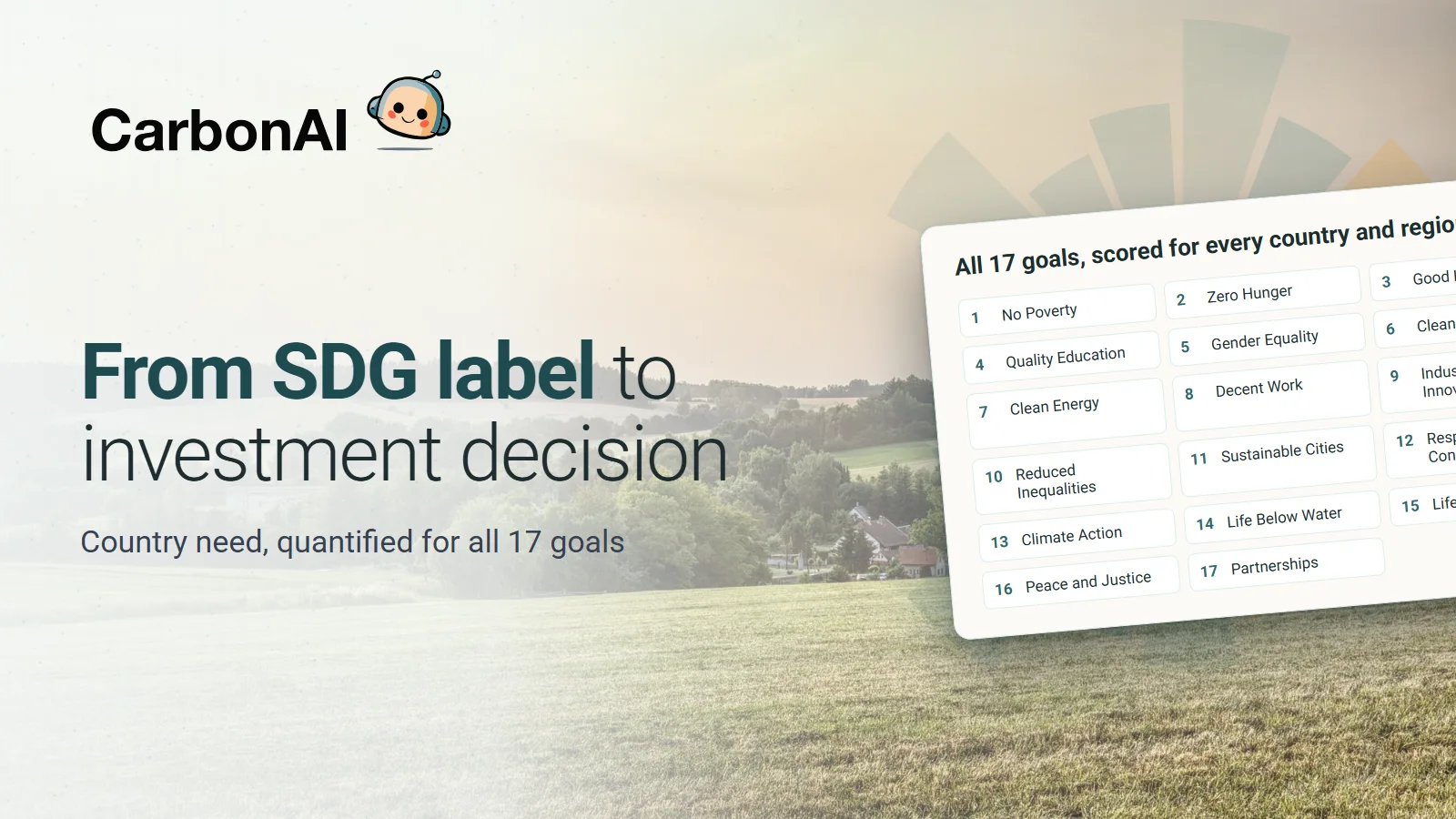
| SDG Impact Index (SDG II) | How closely the project’s targeted SDGs match the host country’s development gaps |
| Country Additionality | Whether reductions are genuinely additional, given the country’s dependence on carbon finance |
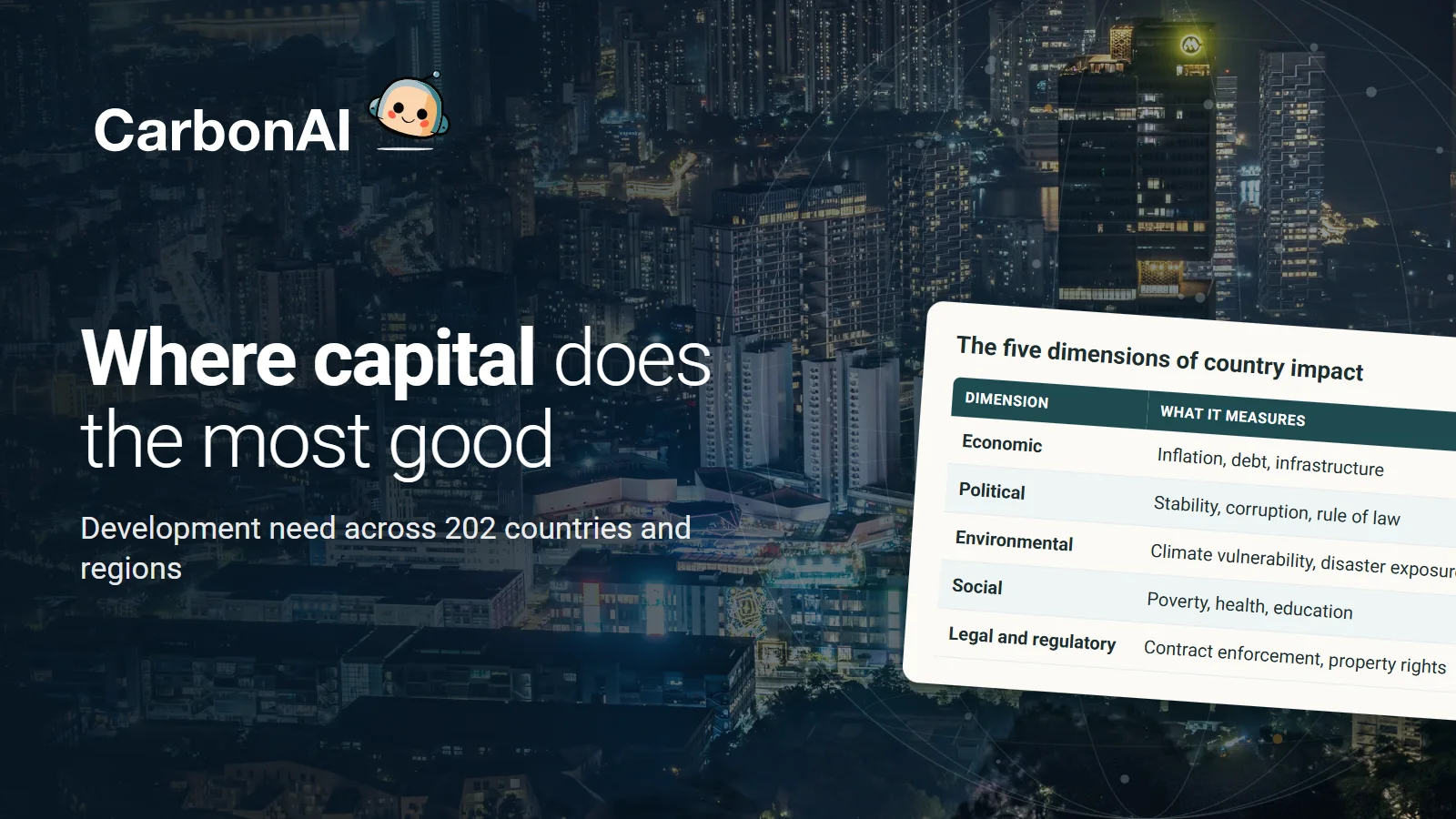
| Country Impact Index (CII) | Host country’s overall development need across economic, political, environmental, social, and legal dimensions |
Who it’s for
- Corporate sustainability teams building or defending an offset portfolio, who need ratings that hold up in front of a board, an auditor, or a CSRD disclosure.
- Procurement and finance leads who have to justify a credit purchase internally and want an independent score to sit alongside the project’s own materials.
- Traders and brokers screening dozens of projects a week against client mandates and risk thresholds, across multiple registries at once.
- Investors and funds running ESG screening or carbon-project due diligence, who need comparable, auditable quality signals across a whole market.
- Due diligence and risk teams who need a structured, evidence-linked starting point for project reviews, with feature-level scores and source citations they can verify, challenge, and document.
- Project developers who want to understand how their projects score against the market, and where improving monitoring or documentation would move the needle.
What you can do with it
- Screen a shortlist in an afternoon: compare twelve candidate projects against one consistent rating instead of commissioning individual reviews for each, cutting weeks of due diligence down to a working session.
- Filter the whole market first: search 11,000+ rated projects across six registries to find options meeting a specific quality or risk threshold before ever opening a project document.
- Monitor an existing portfolio: get weekly-refreshed ratings on credits you already hold, so a slipping project surfaces as an alert, not a news story.
- Back a purchase decision on paper: drop the rating, its feature-level scores, and its cited evidence directly into an investment memo or procurement file.
- Anchor a due diligence review: start from the 13 feature-level scores (additionality, permanence, leakage, monitoring, and more) and follow each citation back to the underlying registry document, turning a blank-page review into a structured verification exercise.
- Compare beyond quality alone: pair each rating with the project’s Country, SDG, and Technology impact scores to answer not just "is this project good" but "good for what we’re trying to achieve."
Why AI-powered ratings outperform traditional reviews
A single analyst reviewing a project file is limited by time, access, and attention, no matter how good they are. Scoring a project across 13 features, against every registry document, methodology, monitoring report, and country indicator available, at the pace the market actually moves, isn’t a labor problem an individual reviewer can solve. It’s a structural one. Here’s how the two approaches compare directly:
| Aspect | Traditional reviews | CarbonAI AI-powered ratings |
|---|---|---|
| Who designs the logic | Individual experts | Domain experts, codified |
| Evidence reviewed | Limited, partial evidence due to time and access constraints | Project and registry documents, methodologies, monitoring reports, country indicators, hazard risk data, and public sources |
| Consistency | Varies by reviewer | Fully standardized |
| Ability to scale | Limited by time and cost | Market-wide by design |
| Updates | Periodic, static | Weekly, near real-time |
| Fatigue and bias | Inherent human limits | None |
| Explainability | Narrative judgment | Evidence-linked and auditable |
| Market context | Project-by-project | Whole-market visibility |
| Methodology | Often undocumented or reviewer-specific | Evidence-based, fully cited with source references, and published transparently |
This isn’t a case of an algorithm deciding what makes a good carbon project. The framework is designed by domain experts: carbon-market specialists define the 13 features every project is scored on, set how each feature is weighted, and decide how much each one matters to the final grade, encoding years of methodological judgment into a single, transparent rubric.
What CarbonAI automates is the heavy, repetitive part no review team can keep up with: reading every registry document, methodology, and monitoring report, extracting the evidence for each feature, and applying that expert-defined rubric identically to every project, every week. Experts decide what good looks like; automation applies that definition consistently at market scale.
The gap isn’t that human reviewers are careless; it’s that they’re working within real constraints on time, access, and consistency. Codifying that expert review logic once and running it against every available document for every rated project is what lets ratings stay standardized, current, and auditable at a scale no review team could match project by project.
Make your next credit decision on evidence. Screen your shortlist against 11,000+ rated projects with CarbonAI Assess.